
In-Between the Boundaries
The limits of labels, and why the experience of not fitting in might be more common than we think.

There is a certain sense of discomfort in living in the in-between space. That melancholy of being nominally a part of a group or a community, but seemingly only existing at the fringes, and never truly belonging in the “inner circle.”
We look around at the people around us, and they all seem so comfortable walking in their identity markers, while ours feel like a conspicuous mask. And everyone have a tribe they can feel right at home in—except for us.
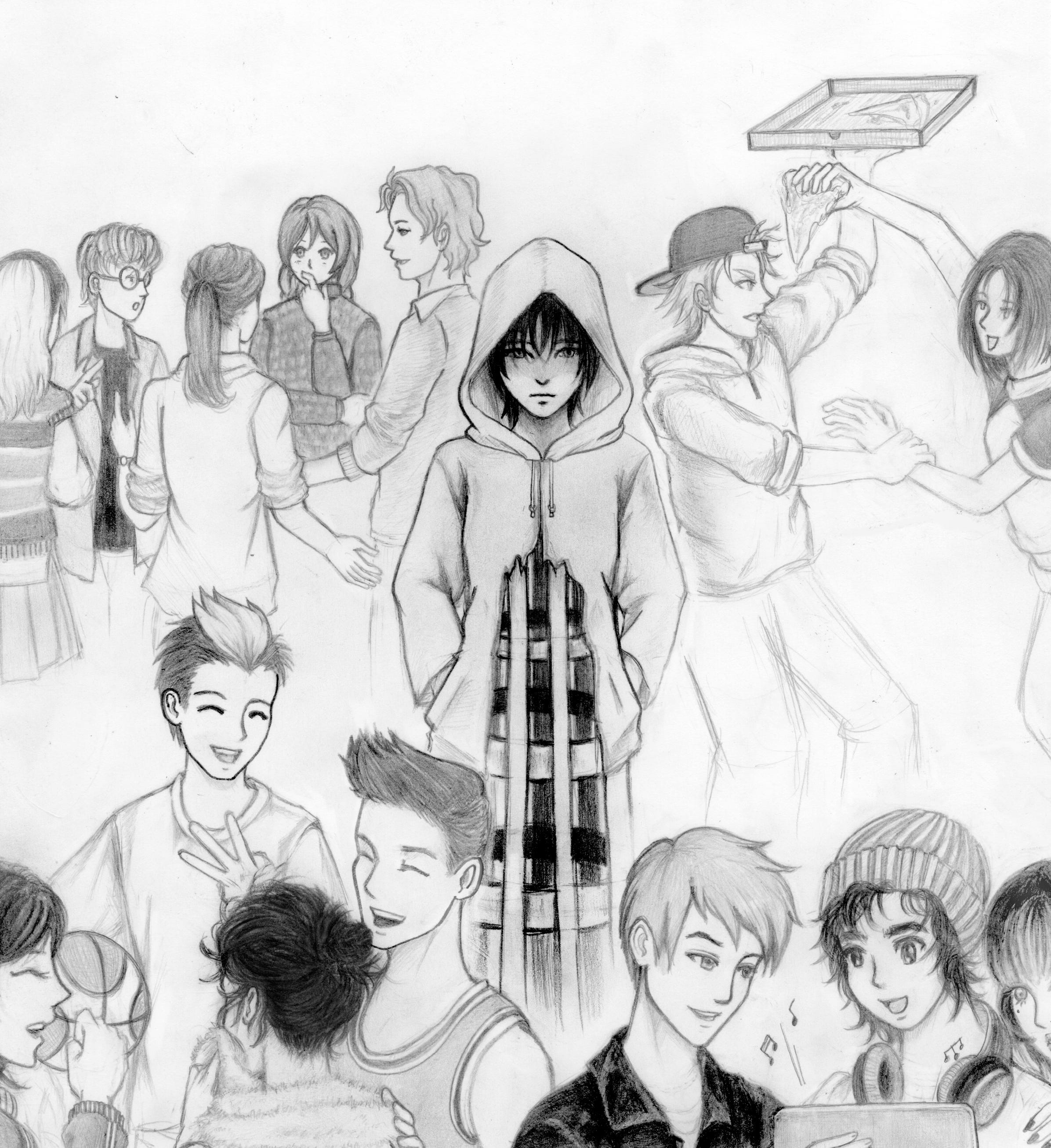
Above is a redraw of an old picture I made for an art Disciple Training School (DTS) course back in 2017. During one of the classes, we were tasked to draw something based on a song, and the song I picked as the basis of this image was Linkin Park’s “Somewhere I Belong.”
And I've got nothing to say
I can't believe I didn't fall right down on my face
(I was confused) looking everywhere, only to find
That it's not the way I had imagined it all in my mind
(So what am I?) What do I have but negativity?
'Cause I can't justify the way everyone is looking at me
(Nothing to lose) nothing to gain, hollow, and alone
And the fault is my own, and the fault is my own
This seemed like a perfect encapsulation of the situation I was then in. Having spent quite some time without a job (or even a decent interview) despite having a degree that was “guaranteed” to be in high demand, I thus entered the DTS track to avoid the need of throwing more and more applications to a wall. There, I discovered that the majority of my fellow students were very different—they were more vibrant, more lively, and had more interesting backgrounds than I did—and within a blink of an eye, they seemed to have formed tight-knit groups I didn’t think I could ever be a part of.
But after I finished the sketch, several of my classmates came up to me and said: “This resonates with me so much.”
Those remarks were astounding. I had thought that the other students had managed to adapt into the DTS community, found their fellow tribemates, and built their second home in this new place. However, their comments about my drawing revealed that even those who appear well-integrated from the outside might not always experience a true sense of belonging.
Sometimes, I wonder if how many people actually does.
The Places We Belong
Few, if any, people enjoy feeling like an outsider. There is a reason why human beings are called social animals, and I have previously written about how our desire to connect with others is innate to our fundamental nature.
C.S. Lewis once addressed this subject in a 1944 Memorial Lecture delivered at King’s College. Drawing from Leo Tolstoy’s War and Peace, Lewis described the existence of an informal, unwritten social hierarchy—embedded within almost every official group or organization—which he referred to as the “Inner Ring”.
“Inner Rings” can manifest in various forms: school cliques, secret societies, business networking, academic research communities, all the way to social media and online platforms. Across the different fields, however, these “inner rings” share many similarities: exclusive jargons, secret codes and knowhow, inside jokes, and unspoken rules. They have no fixed boundaries, no written hierarchies, no formal process of admission nor expulsion, and no defined membership terms. Nevertheless, they follow an unseen hierarchy who decides who gets “in” and those who gets “out.”
Lewis argues that the desire to be a part of an “Inner Ring” is drives much of human aspirations. The promise of belonging in that exclusive circle, to be acknowledged and accepted by the highest rungs of society, and applauded by those outside of it, is an alluring one. And many people caught in this web will sacrifice personal values and authentic relationships for the glamourous distinction of being someone “in the know”.
In Lewis’s own work, the hankering to become part of the “Inner Ring” at the expense of genuine companionship and authenticity, is embodied by the character of Susan Pevensie, from The Chronicles of Narnia series.
First introduced in The Lion, the Witch, and the Wardrobe, Susan was the second-eldest of the four Pevensie siblings, who accidentally wandered into Narnia through a magical wardrobe at the house of Professor Digory Kirke—whom they were sent to live with as war refugees.
Even though Susan’s role in the books were less prominent than her younger siblings’, Lucy and Edmund, she was described as a serious and practical but also a kind-hearted and a mothering figure—in contrast to her more active and imaginative Lucy. When she was eventually crowned as a Queen of Narnia at the end of the book, she became known as Queen Susan the Gentle.
But, after the siblings returned to their own world, Susan became more preoccupied with her social life. Deciding that her prior adventures in Narnia were just fanciful games they all played as young children, her priorities became occupied almost entirely by beauty, fashion, and getting invited into the high society of her school circle. Because of that, her siblings lament, she’s “no longer a friend of Narnia.”
“Oh Susan!” said Jill, “She’s interested in nothing nowadays except nylons and lipstick and invitations. She always was a jolly sight too keen on being grown-up.” — The Last Battle
This development of Susan’s character have been rather controversial, and many have accused Lewis of misogyny—that he is vilifying femininity and feminine expressions of maturity. I don’t believe that is actually the case. Susan’s problem wasn’t her interest in fashion and make-up per se. It was that she had staked her entire identity in them (“she’s interested in nothing else”).
To secure “invitations” from her peers, she denied her history with Narnia—pretending that they were merely “funny games” they all played as kids. She looked down on her siblings for still clinging to that reality and carried herself as being more ‘mature’ for having outgrown” those “fanciful imagination”—when, really, it’s the other way around.
Susan rejected the truth in favour of vanity, and walked away from the genuine bonds she had forged with her siblings and the Narnians to go after that elusive, and ultimately frivolous, “inner circles”.
Where Those Rings Lie
While Lewis’s lecture primarily focused on social hierarchies, I think the underlying problem runs deeper, emerging from the way our minds naturally process information from our surroundings.
In a previous essay, I discussed the our tendency towards apophenia, in which we perceive meaningful patterns and connections where there are actually none. I believe the same cognitive bias that leads us to see faces in clouds and conspiracies in coincidences also causes us to summarily draw categorical boundaries around continuous human variety—and classifying people as “insiders” and “outsiders”.
Consider the following figure:
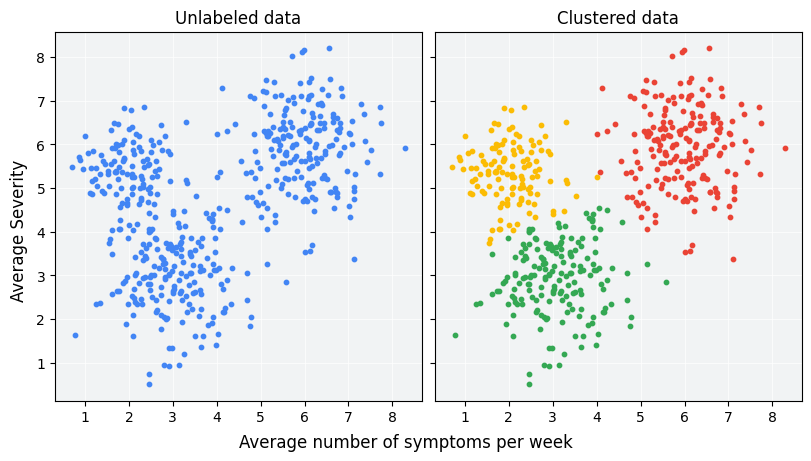
The left window shows raw data points scattered across a plane. The right window shows the exact same data that has been classified into three colour-coded groups. While we might recognize the formation of distinct clusters on the left image, the exact boundaries aren’t actually as clear-cut as what is imposed by the cluster IDs on the right.
In fact, one could even argue that the classification boundaries are somewhat arbitrary. Change the variables slightly, and we might end up with a very different set of clusters: four groups instead of three (or 5, or 10, or a million), Venn diagrams with overlapping boundaries, finding smaller subsets within the larger sets, and so on.
I brought up this illustration in a Discord discussion about neurodivergence, in response to a suggestion that “maybe everyone is neurodivergent, we just haven’t named them yet”. My point was that the diagnostic labels—such as ASD, ADHD, etc.—can still be useful to find support and strategies for managing our specific special needs, but they’re simplifications of patterns.
Real people rarely fit a “pure” cluster. Instead, we might have “symptoms” that only partially fit the existing categories, or have comorbid “conditions”—and treating the labels as fixed, immutable, conditions can be just as harmful as saying that these classifications don’t exist.
I think the analogy can be applied in many other instances of human classification: personality types, love languages, learning styles, social cliques, etc. We often sort people into categories based on their external behaviours or symptoms, and forget that labels alone don’t tell the whole story.
The Power—and Problem—of Labels
Now I am not arguing that labels are inherently harmful or undesirable. Like the symbols I discussed in my previous article, labels are useful simplifiers that can serve as powerful tools for learning, communication, and navigation. Even on this site, we have content tags and genre labels because people are naturally inclined towards certain topics, and these labels help us navigate the bulk of information available on the platform.
At their best, labels help us understand ourselves and others, allow us to communicate our needs more easily, and accommodate other people’s unique strength and weaknesses. However, problems arise when we forget that these classifications are just partial descriptors, and not the complete reality.
Labels are especially harmful when they become rigid and exclusionary. When our entire identities are reduced to a single role or function, and deviating from the “norms” of our categorical label are treated as a violation of natural law, rather than a natural expression of human complexity.
Disney’s High School Musical (2006) provides a vivid illustration of this issue. The film revolves around Troy (a basketball jock) and Gabriella (a scholarly nerd) who discover a passion in theatre/music after being called to sing onstage at a party. This brought them into conflict with their respective peer groups, who thought their new interests would distract them from their “true” identities as a basketball star and member of the school’s Academic Decathlon team.
Tensions peak during the “Stick to the Status Quo” number, in which the entire student body break into a song about, well, sticking to the status quo. Throughout the song, various members of different cliques reveal their hidden passions—a jock who enjoys baking, a nerd who loves hip hop, a skater dude who plays cello—only to be shut down by the rest of their group. The idea being that having hobbies and traits that diverge from your clique’s stereotype breaks an unspoken rule of society, and revealing your hidden sides could threaten your place in your community.
Divergent (2011) takes this a step further. The series is set in society that has been divided into five factions, with each faction representing a specific social category: Abnegation (selflessness), Dauntless (bravery), Erudite (intelligence), Amity (peace), and Candor (honesty). Individuals who who possess aptitude from multiple factions are marked as “Divergent” and considered dangerous.
Much of the story critiques the oppressive nature of the Faction system, and its manifestation was a symptom of a dystopic world. Ironically, the fandom would go on to spawn numerous “Which Faction are you?” quizzes online, with many people proudly declaring the Factions they belong in.
That the audience would embraced a system that the story explicitly condemned is an indicator of how powerful the human desire for categorical belonging can be—even when we might intellectually recognize its failings.
The “In”, the “Out”, and the “In-Between”
From the Inner Rings described by Lewis, to rigid social cliques in high school and beyond, to dystopian factionalism in many speculative fiction, we can see how our natural inclination for pattern-seeking can mutate into increasingly oppressive systems that deny human complexity. What should be a helpful navigation tool becomes an instrument by which we flatten people into stereotypes, and using the labels to claim special privilege, and justify mistreating those who belong in the “other” category.
The realization that most of us don’t fit in neat categories is both freeing and humbling. On one hand, it frees us from the anxiety of not belonging—that the messy, unpredictable, and seemingly contradictory aspects of our personality are natural expressions of human complexity rather than a problem to be solved. On the other hand, this recognition is also a great reminder, that if we are not reducible to simple categories or labels, then neither are other people.
We are not elevated exceptions for being multifaceted, neither are we special exceptions for possessing traits that span more than one classifications. The neighbour, classmate, co-worker, who we might perfectly might actually be struggling with the same sense of not belonging as we do.
The shift is subtle, but while I was working on my “Somewhere I Belong” sketch, I began to notice how easily the sentiment “I’m not good enough to belong anywhere” can flip into vain conceit: “these categories other people belong to are not good enough for me”. In rejecting the categorical constraints, we unwittingly end up forming a new categorical hierarchy—a new Inner Ring, a new dividing line—where being uncategorizable becomes the highest ring of them all.
In the end, perhaps the path forward isn't finding the right category or rejecting all labels entirely, but learning to hold classifications lightly—as useful tools rather than ultimate truths. When we stop mistaking the map for the territory, we can finally see each other clearly: not as representatives of groups or embodiments of traits, but as fellow travelers navigating the beautiful complexity of being human.
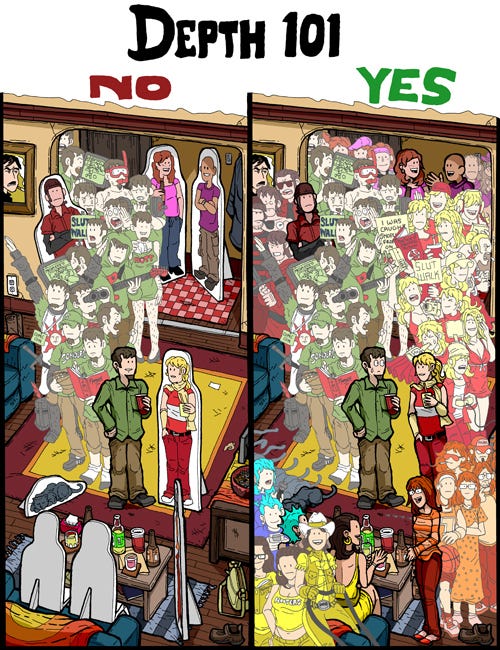
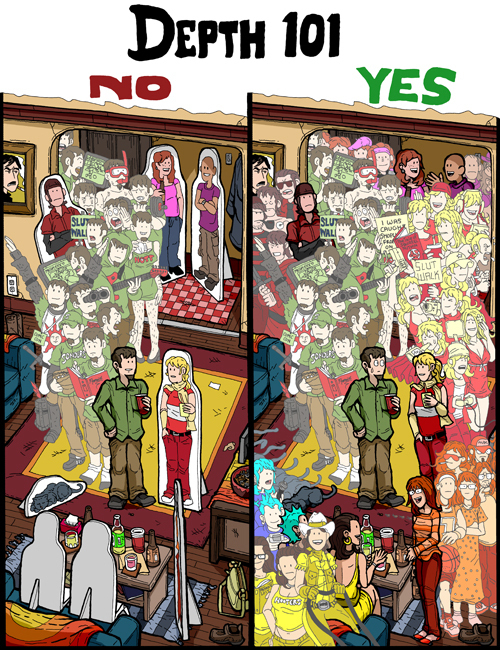
Your artwork and the story behind it stay with me. Knowing it grew from Somewhere I Belong gives every pencil line a echo of that song’s ache standing in the noise yet somehow apart from it. The petticoat-like frame inside the figure feels like both scaffolding and cage, the hidden structure we lean on to shape ourselves and the fragile shell that keeps us from true belonging. It mirrors the article’s call to hold labels lightly and to face the mystery in ourselves and in others without fear. Isn’t it striking how art and music can show that the very frameworks we trust to define us are often the ones we must eventually shed?