
The Divine Fingerprints
Witnessing natural revelation in the created world.


Once upon a time, when I was still working as an academic at a local STEM institute, the Rector of the institute I served shared the following meme:
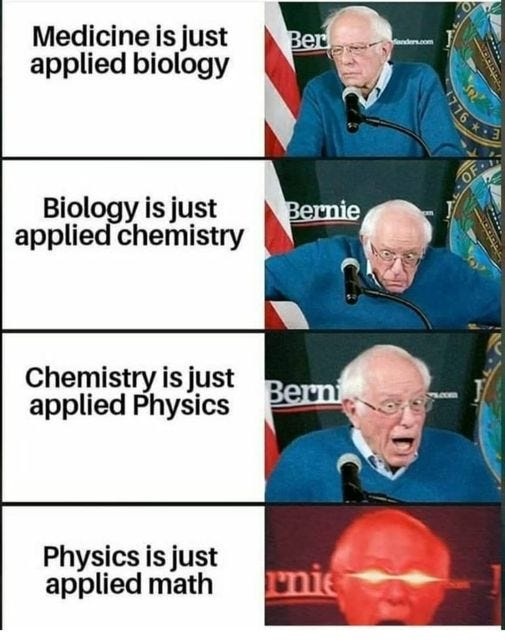
Beneath this meme, the Rector—himself a former pastor with a PhD. in Physics—added the following caption: “And math is just applied theology.”
His sentiment echoes an adage, often attributed to Galileo Galilei, which says: “Mathematics is the language in which God has written the universe.”
It was a lighthearted post, but the implication was profound: beneath the layers of scientific disciplines lies a deeper metaphysical reality—a logic, or Logos—that transcends the equations.
To study science is, in this view, to trace the fingerprints of God.
In Romans 1:20, Paul states, “For since the creation of the world God’s invisible qualities—his eternal power and divine nature—have been clearly seen, being understood from what has been made, so that people are without excuse.”
This is an astute claim. Even non-theists, at times, acknowledge the apparent intelligent design or fine-tuning of the universe. However, every time I see natural arguments for the existence of God, I’ve always wondered, “Can the study of nature reveal the identity of this designer beyond a vague source of intelligence?”
So, I did a little more digging into math, science, and the hermeneutics of Biblical symbols to see where—or, rather, who—the “fingerprints” of nature really points to.
I have summarized the answers I found into a poetic form, shown below:
the poem
The coloured space refracts the Creator's essence
A vision soaked in palettes with threefold lens
RGB, HSV, or Lab—three in dimension, yet one in hue
In every shade and gradation, His light shines throughThere are no depths from which He does not gleam
In blackest nights, faint sparks can still be seen
A triune of quarks swirl in quantum lore
Chromodynamic sparks weld together the atoms' cores.Galaxies ignite where the elements unite
As trichrome charge converges to white
'Til eons pass and the stars cave in
And remnant dusts collide to birth new kinWhat wondrous run, what state of art!
The world we tread on beats with iron heart
Fe, atom number 26, is a sacred sign
To the tetragrammaton, YHVH, His name divineThen to its mass, add neutrons—30 in all
The age when priests (and Christ) are given call
As Iron-56 stands, most stable of time and space
Thus our lives shall be, when yielded to His graceIn all of this the bonds shout eight-point-eight
When fusion peaks, new dawn shall propagate
Through life of stars the Spirit breathes
Through crimson blood that iron sheathesAbundant life is encoded within the Son's name
As the oxygen in air sparks resurrection's flame
Even the atmosphere bear witness to the cross
The Word is inscribed in all of cosmosThus Nature's Laws pulsate with His decrees
Woven in Love, not random debris
From stellar breaths to fermion spins
Every speck of existence are God's fingerprints
The Arithmetic of Meaning
Language and arithmetic are closely intertwined in many traditional alphabet systems, where each letter is assigned a specific numerical value for mathematical operations. The practice of adding up the numerical values of letters in a word—especially in names—is called gematria or isopsephy.
Subsequently, many cultures have developed their own forms of numerology—in which special meanings are attributed to numbers—and the Bible is no exception. The following is a non-comprehensive list of “Biblically significant numbers” referenced in the above poem:
3 - The number of divine completeness/perfection.
Associated with the Trinity (Father, Son, Spirit).
The three patriarchs of God’s covenant people: Abraham, Isaac, and Jacob.
God being described as "Holy, Holy, Holy" in Isaiah 6, with the triple repetition signifying an ultimate superlative.
Jesus raised from the dead after three days.
8 - The number of resurrection or new beginnings. The start of a new cycle after the number of completion (7).
The number 8 in Hebrew alphabet, chet (ח), is associated with the word chai (חי), which means life.
During Noah's day (the Great Flood), 8 people were preserved in the ark, symbolizing the new beginning for humanity.
Jewish male children are circumcised on the 8th day, as a mark of entry to the covenant.
Jesus rose from the dead on the first day of the week, or the 8th day if you're counting from the previous Sunday.
In Koine Greek (the language in which the New Testament is written), Jesus's name, ΙΗΣΟΥΣ (Iēsous), adds up to 888:
I (iota) = 10
Η (eta) = 8
Σ (sigma) = 200
Ο (omicron) = 70
Υ (upsilon) = 400
Σ (sigma) = 200
10 + 8 + 200 + 70 + 400 + 200 = 888
26 - Not as explicitly emphasized in the Scriptures as other numbers, but still considered very significant in Jewish tradition because it is the gematria of the tetragrammaton (the personal name of God), YHVH = Yod (10) + He (5) + Vav (6) + He (5) = 26.
30 - The age of ministry. Priests start their duties at age 30 (Numbers 4:3). Jesus and David also took up their call at a similar age (2 Samuel 5:4, Luke 3:23).
Applied Cosmology
Curiously, we can see many echoes of these numbers embedded in the very fabric of the natural world:
The coloured space refracts the Creator's essence
A vision soaked in palettes with threefold lens
RGB, HSV, or Lab—three in dimension, yet one in hue
In every shade and gradation, His light shines through
This stanza refers to the colour theory. Colour information is typically expressed as trichromacy because most organisms possess three types of cone cells in the eye that are sensitive to different light wavelengths: long (red), medium (green), and short (blue).
As a result, most colour spaces (e.g., RGB, HSV, and L*a*b*) are organized as three-dimensional tuples, where each of the three channels contributes to a single perceived colour—just as God is three in Persons, yet one in Essence.
The word “refracts” in the first line is a deliberate choice. Refraction refers to the redirection of a wave (particularly light) as it passes from one medium to another, and colour becomes visible when light is dispersed through a prism. In the same sense, though we do not see God face to face, we can witness facets of His glory refracted through creation: in the unity and diversity of colours, in the beauty of life, and in the richness of human experience.
Some colours shine vividly, while others carry subtler hues; but whether the Lord moves in the fire and whirlwind, or speaks in a still, small voice, His remains present—guiding from above, surrounding us in grace, and dwelling within us.
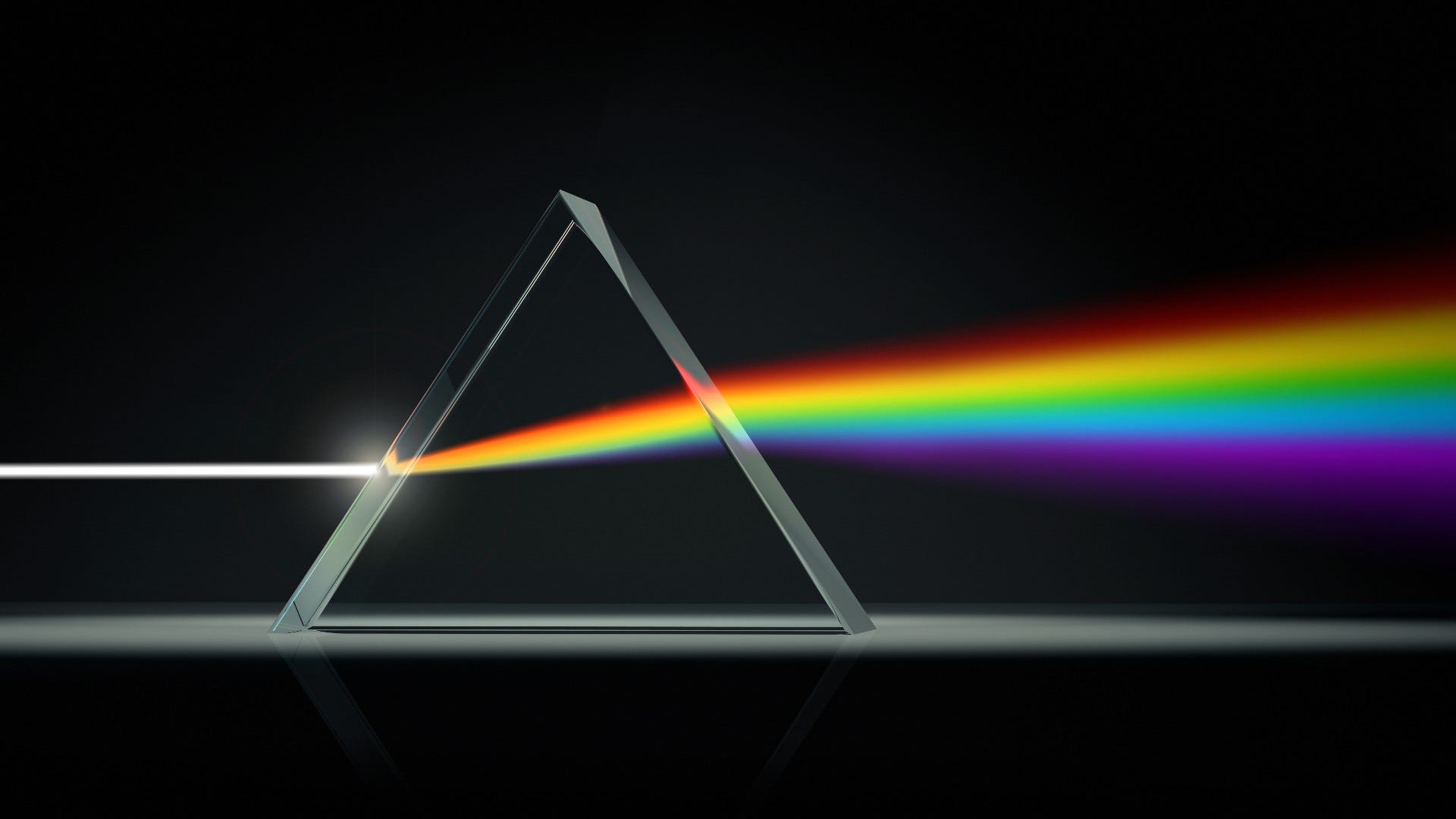
There are no depths from which He does not gleam
In blackest nights, faint sparks can still be seen
From a scientific perspective, there is no such thing as a truly black substance; every material object reflects at least a small measure of light. Even Vantablack—the darkest pigment currently known—can still reflect approximately 0.035% of light. Total darkness, in this sense, does not exist.
Theologically, this serves as a metaphor for the omnipresence of God. There is no place so dark, so hidden, or so broken that He cannot shine through. As the psalmist declares, “If I go up to the heavens, you are there; if I make my bed in the depths, you are there” (Psalm 139:8). The presence of God transcends both place and condition; He is with us not only in triumph and revelation, but also in desolation, silence, and mystery. As Paul affirms in Romans 8:31–39, nothing—not even death or despair—can separate us from the love of God that is in Christ Jesus our Lord.
A triune of quarks swirl in quantum lore
Chromodynamic sparks weld together the atoms' cores.
The scientific metaphor then zooms into the invisible realm of quantum mechanics. Most hadrons (including the protons and neutrons within the atomic nuclei) are made up of three quarks; these three quarks exist in a constant state of dynamism, and the interactions between them generate the strong force that holds the nucleus together.
This once again echoes the Trinity, in which the three divine Persons—Father, Son, and Holy Spirit—exist in a perfect, eternal communion of love and relational dynamics. Just as the quarks are never isolated and only exist in relation to one another, so too the Persons of the Trinity are distinct yet indivisible, bound together by the essence of shared divinity and love. In both cases, it is the unseen relational energy that holds the centre—whether the nucleus of matter or the mystery of divine being.
Galaxies ignite where the elements unite
As trichrome charge converges to white
As previously elaborated in my Language of the Universe article, the strong nuclear force—governed by the theory of quantum chromodynamics (QCD)—is responsible for the process of nuclear fusion that powers up the stars and ignites galaxies. QCD teaches us that quarks possess what is called "color charge"—a metaphorical label drawn from light’s primary colors: red, green, and blue. In protons and neutrons, each of the three quarks carry one of these distinct color charges, which together form a “color-neutral” (white) state. Only such unified, color-neutral particles can exist freely in the universe. This scientific principle finds poetic and theological resonance in the line, “as trichrome charge converges to white”.
Here, color theory, particle physics, and Trinitarian theology converge: three distinct charges, like three Persons of the Trinity, coexist in perfect harmony to form something whole, balanced, and free. Just as fusion binds elements into radiant light, so divine unity brings forth creation and life. The structure of matter, from quarks to galaxies, becomes not merely a product of force, but a reflection of divine order—of a God whose being is communion, and whose signature is unity through diversity.
'Til eons pass and the stars cave in
And remnant dusts collide to birth new kin
But not even the stars are spared from a timely demise. Once their inner cores exhaust themselves after producing iron—the element too stable to fuse further—the star begins to collapse under its own weight. Overcome by gravitational forces, the dying embers unleashes one final spark and explodes into a brilliant supernova.
From this starry blast, iron and other elements are scattered across the cosmos. These stellar dusts drifts through space and mingle with clouds of gas called nebulae. Over time, gravity gathers the broken fragments, drawing them into clumps that would grow to become new stars and planets—new life born from the ruins of celestial decay.
What wondrous run, what state of art!
The world we tread on beats with iron heart
Fe, atom number 26, is a sacred sign
To the tetragrammaton, YHVH, His name divine
This stanza begins with a doxological praise, expressing awe at the elegant complexity of the universe. The phrase "wondrous run" evokes not a static cosmos but a dynamic, unfolding symphony of creation, sustained and in motion. Meanwhile “state of art” is a play on the term “state-of-the-art”, which refers to the highest level of general development, as of a device, technique, or scientific field achieved at a particular time. But even though the universe exists long before scientific and technological advancement, nature’s designs continue to serve as inspirations for human endeavours.
From the Heavens that house the galaxies, the poem then descends into the heart of the Earth, where its primarily iron core resides. The molten iron that makes up the Earth’s core generates magnetic field that shields life from harmful solar radiation, making iron essential for the habitability of the planet we live in.
However, this scientific fact is also rich with Biblical symbolism: Fe (or ferrum, the chemical symbol of iron) has an atomic number of 26; in Hebrew alphabet, the four letters of God's covenantal name—Yod (10), Heh (5), Vav (6), Heh (5)—sum to 26.
Thus, iron exists as something beyond a mere physical element; it is the very imprint of the Creator present in stars, in the Earth's core, and within our own blood—becoming the thread that links the cosmic, the terrestrial, and the human.
Then to its mass, add neutrons—30 in all
The age when priests (and Christ) are given call
As Iron-56 stands, most stable of time and space
Thus our lives shall be, when yielded to His grace
This stanza extends the parallel between the atomic structure of iron and the spiritual framework needed for stability. Iron-56, the most stable isotope, is made up of 26 protons and 30 neutrons—a number which, in Scripture, represents ministry and mission. It is the age at which Levites began their priestly service (Numbers 4:3) and the age at which Jesus commenced His public ministry (Luke 3:23).
This suggests that we achieve our most stable self when we surrender our lives to God’s mission, where grace becomes the binding force—like the strong nuclear force—that holds our soul together.
In all of this the bonds shout eight-point-eight
When fusion peaks, new dawn shall propagate
Through life of stars the Spirit breathes
Through crimson blood that iron sheathes
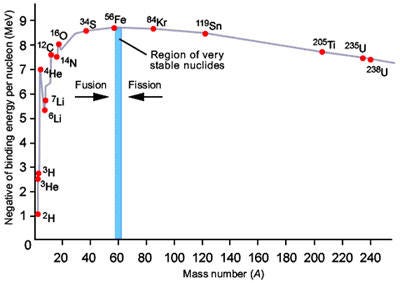
The reference to “eight-point-eight” in this stanza alludes to the 8.8 MeV binding energy per nucleon of Iron-56, which marks the peak of fusion efficiency in stars—a cosmic tipping point where creation through fusion gives way to death and transformation. This number resonates with the Biblical numerology of 8, symbolizing new beginnings and resurrection.
The connection between theology and nature can be further observed through oxygen, element number 8 on the periodic table, which enables breath and binds to iron (element 26, which as previously mentioned, is numerically tied to YHWH) in hemoglobin—thus forming the life-sustaining flow of blood.
In this way, oxygen becomes a symbol of both biological vitality and spiritual rebirth, and when paired with iron, it reflects a divine signature: oxygen (8) as new life, iron (26) as God’s name, and blood as the vessel of sacrifice and grace through Christ.
Abundant life is encoded within the Son's name
As the oxygen in air sparks resurrection's flame
Even the atmosphere bear witness to the cross
The Word is inscribed in all of cosmos
Jesus once said that He had come to give [His flock] life, and that they might have it abundantly (John 10:10). In 1 John 5:12, the apostle further affirms, “The one who has the Son has this eternal life.” These statements perfectly mirror the isopsephy of Jesus’s name, ΙΗΣΟΥΣ = 888—a trinity of eights representing the perfect resurrection and new beginning.
Once again, oxygen serves as a powerful metaphor to the spiritual realities expressed in Scripture. Oxygen—which enables respiration, combustion, and sustains life itself—becomes a symbol for the life-giving Spirit, who acts as the agent of resurrection (Romans 8:11).
The Hebrew word ruach and the Greek pneuma both mean “spirit,” “breath,” and “wind,” and the association between wind and the supernatural has pervades through many cultures. Indeed, the word “spirit” is derived from the Latin word spiro, which means “to blow, breathe”, and we see a similar association in words like “respiration.”
In the Bible, God breathes into Adam the breath of life, and the man becomes a living being (Genesis 2:7). Similarly, John 20:22 portrays Jesus breathing on His disciples, saying, “Receive the Holy Spirit.” These passages demonstrate the Spirit as the animating force behind creation—the living embodiment of divine breath.
The Spirit also manifests as fire—most notably in Acts 2, at Pentecost, where tongues of fire rest on the disciples. Fire here represents purification, presence, and power—the divine energy that consumes, transforms, and commissions.
Hence, the phrase, “as the oxygen in air sparks resurrection's flame,” connects the way oxygen enables combustion to the way the Spirit ignites resurrection and renewal.
Thus Nature's Laws pulsate with His decrees
Woven in Love, not random debris
From stellar breaths to fermion spins
Every speck of existence are God's fingerprints
In this final verse, the poem brings its meditation cosmic analogies to a conclusion: the universe is not a product of random forces, but a grand tapestry intentionally woven by a personal, loving God. Nature’s laws harmonize with each other divine rhythm and order, like a serenade waiting to be heard by those willing to listen.
From the grand scale of “stellar breaths” to the tiniest “fermion spins,” every level of existence reflects intentional design and purpose. The image of God's "fingerprints" on “every speck of existence” affirms that creation is both intimate and sacred. It is a universe that testifies, at every scale, to its Creator’s presence, artistry, and care.
The Fe made me think of the Hebrew word for soil and red. Humus, human, adam. We are Earthlings made of iron dust - the red of our blood.
Thanks for thinking (in response to my comment elsewhere on the Following Jesus Substack) that this might catch my interest, as it most certainly does! I'm always a bit concerned for clean discernment when reading things like this, that observations like these seem too esoteric or lofty, and God forbid - Gnostic, false and misleading. But you've made no secret heretical fabrications in these ultimately rather plain (though wonderous) observations. I like your poem quite a lot, but honestly would have missed much of it's meaning without the elaboration, so thanks for that. Definitely fun stuff for word and number nerds! 😂